 How-to
How to Find Qualified Automotive Workshop Mechanics
Last Updated: November 2, 2026
Quick Summary
To find qualified automotive workshop mechanics, start with a clear job description covering core tasks, vehicle types, tools and working pattern. Then confirm the qualifications that truly matter, source candidates through referrals and targeted channels, and screen applicants against the same criteria.
- Write a job description covering core tasks, vehicle types, required systems, reporting line and working pattern.
- Decide which qualifications are essential and which are helpful, and ask for evidence of competence.
- Confirm that overseas qualifications are recognised in Australia before ruling candidates in or out.
- Use referrals, industry networks and specialist recruiters, since many top mechanics are not actively job hunting.
- Test skills with a short, realistic practical assessment and score every candidate against the same criteria.
Table of Contents
- Start With a Clear Job Description
- Confirm the Qualifications That Matter for Your Workshop
- Know Where to Advertise and Source Candidates
- Screen Applications Before Interview Day
- Prepare the Right Interview Questions
- Test Practical Skills With an Assessment
- Check References and Make Your Offer
- Frequently Asked Questions
Start With a Clear Job Description
Automotive People Group places automotive workshop mechanics across the industry. The first thing we check on any brief is the job description. A vague one attracts vague candidates. A clear one filters the right people in before a single interview is booked.
Start by writing down the job in plain terms. What will the mechanic actually do on a normal day? Which makes and models? Which systems? Who do they report to?
Your description should cover:
- The core tasks, such as diagnostics, servicing, panel work or EV battery checks
- The vehicle types you work on, including brands and any specialist platforms
- The tools and systems the person must already know
- The reporting line and who they work alongside
- The working pattern, including shifts, weekend cover and on-call duties
A common mistake is copying an old advert and changing only the company name. Candidates notice this, and so do the best ones. They want to see what has changed in your workshop.
Be honest about the pay range and the progression path. Vague salary wording costs you applicants before they even apply.
Confirm the Qualifications That Matter for Your Workshop
Not every certificate matters for every role. A general service technician and an EV diagnostic specialist need very different backgrounds. Decide which qualifications are essential and which are simply helpful.
Check for:
- Trade certification recognised in Australia, such as an apprenticeship completion or a nationally recognised automotive qualification
- Manufacturer training for the brands you service
- Licences and compliance relevant to your state or territory, including the workplace health and safety rules that apply to your premises
Be careful not to make every qualification mandatory. You may lose strong mechanics who learned on the job and hold equivalent skills. Ask for evidence of competence, not just a piece of paper.
Watch out: a qualification from another country may not map directly to an Australian equivalent. Confirm recognition before you rule someone out, or in.
Know Where to Advertise and Source Candidates
Job boards work for volume, but they rarely reach experienced technicians who are already employed. Many of the best mechanics are not actively searching. They respond to a direct approach, a referral or a well-targeted advertisement.
Consider a mix of channels:
- Your own website and social media, which show candidates what working with you is like
- Industry networks and trade associations
- Referrals from current staff, often the most reliable source
- Specialist recruiters, who can approach people who are not job hunting
Recruitment agencies charge fees that vary with the role and the search, and they can save time and widen your reach. Before committing budget, you can compare recruitment agencies against job boards. Whether that trade-off is worth it depends on how hard the role is to fill. For a single entry-level technician, a job board may be enough. For a senior diagnostic specialist, an agency may be worth considering. For current pricing, visit the Automotive People Group website or request a quote.
Ask yourself: where have your best past hires come from? Start there.
Screen Applications Before Interview Day
Interviews take time. Screening applications first protects that time. You can find recruitment guidance specific to service centres to help sort applicants. Build a simple checklist and apply it to every application in the same way.
Look for:
- Relevant experience in the brands and vehicle types you need
- Recent work, because technology changes fast in this trade
- Clear progression from one role to the next
- Evidence of the qualifications you decided were essential
Use the same criteria for everyone. This keeps your decisions fair and easier to defend.
Phone screens help too. A short call of 10 to 15 minutes can confirm availability, pay expectations and whether the candidate has the core skills you need. Many weak applicants drop out at this stage, which saves everyone effort.
Use these checks to screen applications consistently before any interview is booked.
| Screening check | What to look for | Why it matters |
|---|---|---|
| Relevant experience | Work on the brands and vehicle types you need | Matches the candidate to your workshop |
| Recent work | Current knowledge of fast-changing technology | Technology changes fast in this trade |
| Clear progression | A logical step up from one role to the next | Shows steady skill growth |
| Essential qualifications | Evidence of the certificates you marked essential | Confirms baseline competence |
| Phone screen | Availability, pay expectations and core skills in 10-15 minutes | Drops weak applicants before interviews |
Prepare the Right Interview Questions
Good interview questions reveal how a mechanic thinks, not just what they remember. Prepare your questions before the interview, and ask every candidate the same core set.
Useful questions include:
- "Walk me through how you diagnosed a fault you found difficult."
- "What do you do when a repair takes longer than the time booked?"
- "How do you keep your knowledge of new vehicle systems up to date?"
- "Tell me about a time you disagreed with a service adviser about a repair."
- "What would you expect in your first 90 days with us?"
Include a few questions about safety and compliance. A mechanic who cuts corners on safety is a serious risk to your business and your customers.
Ask the candidate questions too. Strong mechanics ask about tools, training budgets and workshop culture. Their questions tell you what they value.
Test Practical Skills With an Assessment
Talk is cheap. A practical assessment shows whether the candidate can actually do the work. Keep the test realistic, short and relevant to the role.
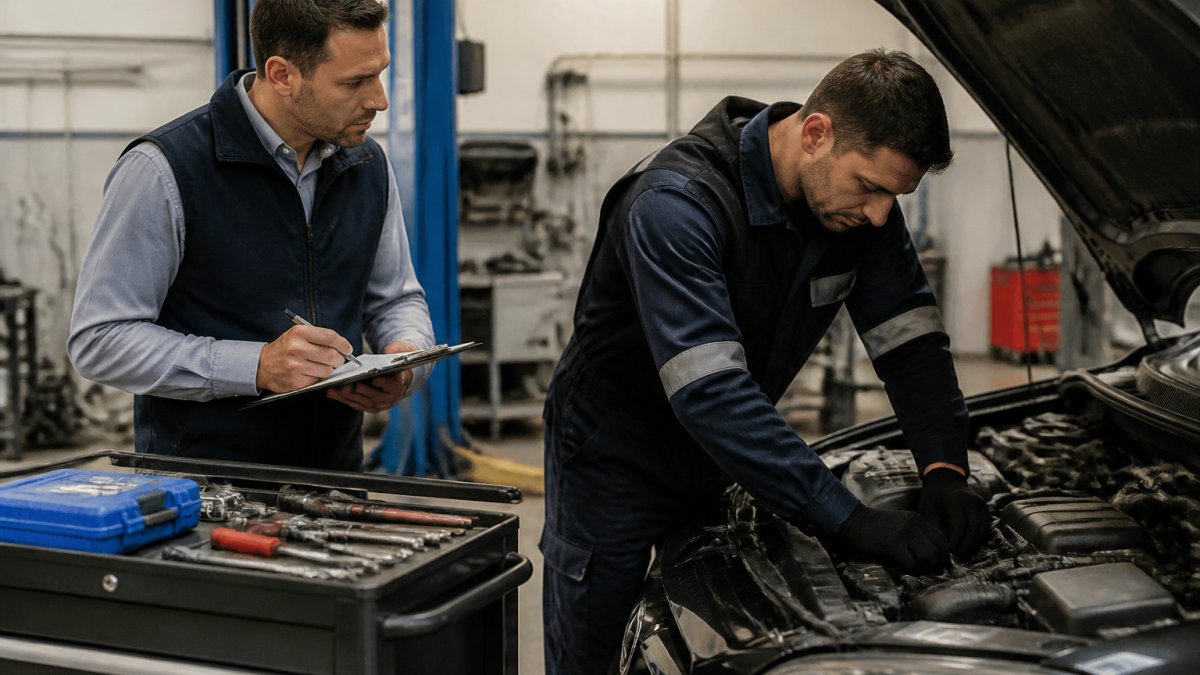
Options include:
- A diagnostic exercise on a vehicle with a known fault, where the candidate explains their process aloud
- A servicing task, such as a brake inspection or a standard service check
- A written scenario, where the candidate explains how they would handle a customer complaint about a repair
Tell candidates in advance what the assessment involves and how long it takes. Pay them for their time if the test is lengthy. Good candidates may walk away from a long, unpaid trial.
Score each candidate against the same criteria. Note accuracy, safety, communication and how they handle unfamiliar problems. A candidate who admits they do not know something and explains how they would find out often shows better judgement than one who guesses.
Check References and Make Your Offer
References confirm what the interview could not. Ask for two or three recent references, ideally from a supervisor. Ask specific questions: Was the candidate reliable? How did they handle pressure? Would the reference hire them again?
Check their qualifications and any licences you have confirmed as essential. Keep a record of what you checked and when.
When you make the offer, put the key terms in writing. Include the role, pay, hours, start date and any probation period. Clear terms from the start prevent disputes later.
If you want support finding qualified automotive workshop mechanics, Automotive People Group works with employers across the industry. Let's talk about your next hire.
Frequently Asked Questions
How do you find qualified automotive workshop mechanics?
Start by writing a specific job description that lists the vehicle types, systems and workshop tasks the role covers. Then advertise on automotive job boards, trade associations and local TAFE and training provider networks, and ask your existing staff for referrals. Qualified mechanics are often found through word of mouth, so a clear role brief and a respectful hiring process help you attract candidates who are already working well. Specialist recruiters can also reach people who are not actively applying.
What qualifications should an automotive mechanic have?
In Australia, most workshop mechanics hold a Certificate III in Automotive Mechanical Technology or an equivalent trade qualification, and a trade-recognised apprenticeship is the usual pathway. Check that the qualification matches the work you need, such as light vehicles, heavy vehicles or diesel. Ask for proof of completion and, where relevant, licences or certificates for specific work. Experience matters too: a candidate with fewer formal credentials but a strong, verifiable track record may still be the right fit.
How can employers assess a mechanic's practical skills?
Use a short, supervised practical test that reflects real workshop tasks, such as diagnosing a fault on a vehicle, replacing brake pads or using a scan tool to read fault codes. Set a clear time limit and score the candidate against a checklist covering accuracy, safety, tool use and communication. Keep the test relevant to your workshop's typical work so the results tell you something useful.